January 24, 2026
Article
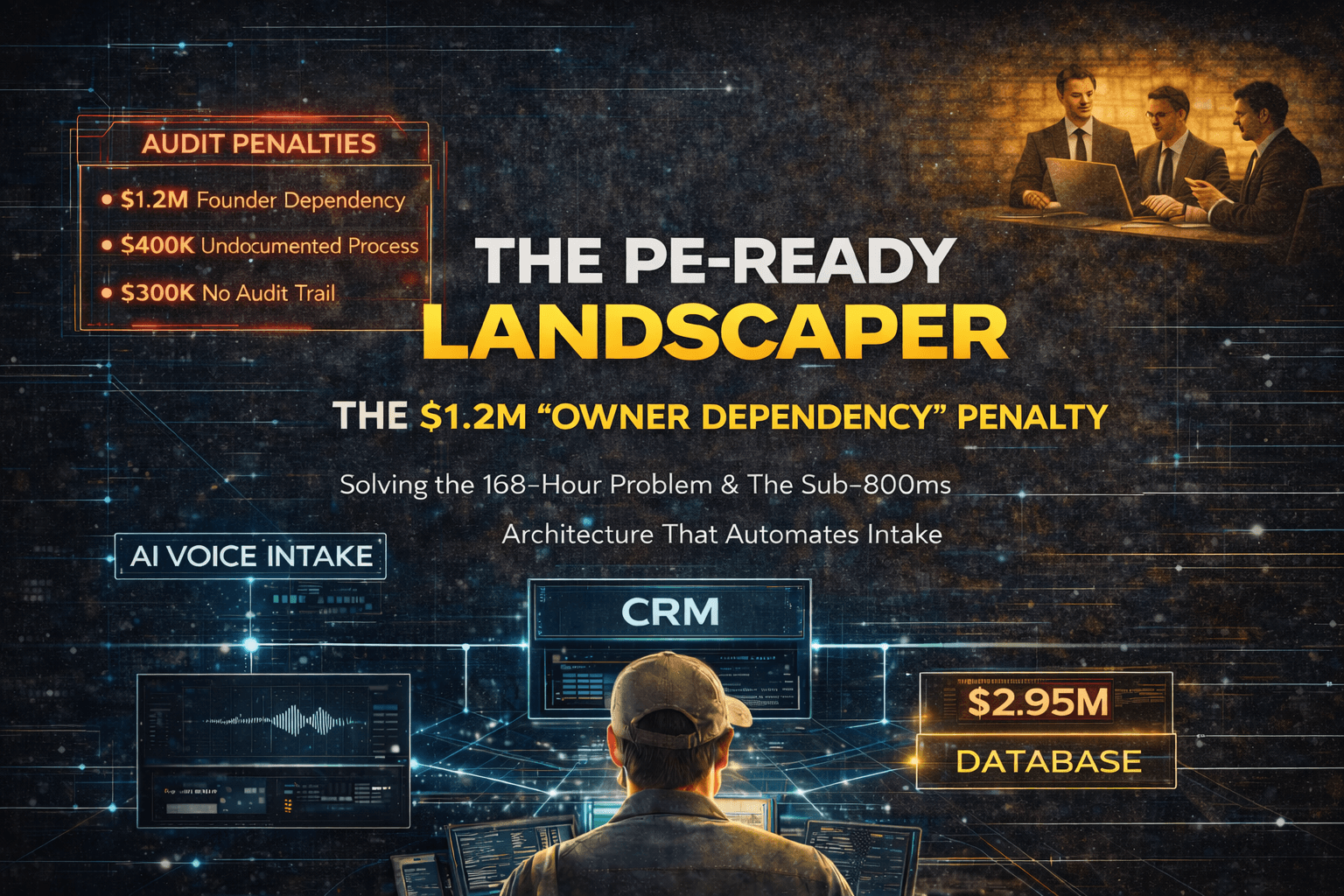
THE PE-READY LANDSCAPER: THE $1.2M "OWNER DEPENDENCY" PENALTY
Solving the 168-Hour Problem & The Sub-800ms Architecture That Automates Intake
A Technical Documentation on Engineering Owner-Independent Intake Infrastructure for Private Equity Exits
EXECUTIVE SUMMARY
The Problem: Private Equity firms apply a "Key Man Risk" penalty to landscape contractors where the owner handles intake.
The Cost: Average valuation reduction of $1.2M - $1.5M.
The Root Cause: The "168-Hour Problem" (43% of leads call after hours; human coverage destroys EBITDA).
The Solution: A "Sub-800ms" Voice AI architecture running custom routing logic that operates as a fully integrated employee.
The Architecture:
Voice Layer: Vapi + Deepgram Nova-2 (Latency <800ms)
Logic Layer: Llama 3.3 70B on Groq (Inference)
Orchestration: Make.com Middleware (Traffic Control)
Database: Supabase/PostgreSQL (Audit Trail)
Integration: Bi-directional sync with LMN & HubSpot
The ROI:
Operational: 18x-35x returns on revenue capture.
Exit Value: $2.2M+ in valuation protection.
Implementation Time: 4 weeks.
TABLE OF CONTENTS
Use Ctrl+F (or Cmd+F on Mac) to jump to any section
PART 1: THE BUSINESS CASE
The Tale of Two Exits
The 168-Hour Problem
The Human Solution (And Why It Destroys Your EBITDA)
The Private Equity Paradox
Why Voice AI Is the Only Viable Solution
PART 2: THE LATENCY PROBLEM
Why Most Voice AI Fails
The "Cheap Robot" Brand Damage Signal
The 800-Millisecond Rule
Where Latency Lives (The Technical Breakdown)
The Stack Selection Criteria
PART 3: THE INTEGRATION LAYER (THE "ENTERPRISE STANDARD")
Section 3.1: Why Direct Integration Fails
Section 3.2: The Logic Layer (Function Calls)
Section 3.3: The "Live Lookup" (The Secret Weapon)
Section 3.4: The Write Layer (LMN + HubSpot Integration)
Section 3.5: The Fail-Safe (Retry Queue & Redundancy)
PART 4: THE AUDIT TRAIL & GOVERNANCE
Section 4.1: The Shadow Database (Supabase/PostgreSQL)
Section 4.2: The PE-Ready Dashboard
Section 4.3: Compliance & Governance Documentation
PART 5: IMPLEMENTATION & ROI
Section 5.1: The Build Process
Section 5.2: The Investment Breakdown
Section 5.3: The ROI Calculation
PART 6: WHO THIS IS FOR & WHAT'S NEXT
Section 6.1: Who Should Build This
Section 6.2: The Timing Question
Section 6.3: The Infrastructure Stack
Section 6.4: What's Next in This Series
PART 1: THE BUSINESS CASE
The Bridge
Last week, I broke down 11 infrastructure red flags that destroy enterprise value during PE due diligence. [Link to Article] The response was overwhelming. The most requested follow-up: Red Flag #1 - Founder Dependency.
Here's the thing about Founder Dependency: It's not a single problem. It's a three-headed beast that lives across your entire operation.
The Three Layers of Founder Dependency:
Layer 1: Intake - Who captures leads 24/7 when the phone rings?
Layer 2: Sales - Who qualifies, estimates, and closes deals?
Layer 3: Operations - Who makes critical field decisions when problems arise?
PE firms audit all three. But the first place they kill you - the place where most $3-8M contractors fail immediately - is Intake.
If the owner answers the phone personally, or if leads go to voicemail outside business hours, the valuation collapses before you even get to discuss sales process or operational independence.
This is the technical deep dive on solving the Intake layer of Founder Dependency.
Not theory. Not best practices. The actual architecture used by contractors preparing for PE acquisition. The stack that passes operational due diligence. The system that eliminates Red Flag #1 permanently.
Sales and Operations will be covered in future articles. But first, you need to understand how to capture leads without the owner being the bottleneck.
Because if you can't prove the business captures and qualifies leads 24/7 without founder involvement, the rest doesn't matter. PE walks away or slashes the offer.
Let me show you why.
The Tale of Two Exits
I’ve sat on the buy-side of the table for deals exactly like this. My job was simple: Audit the operations, find the risks, and report back to the Private Equity Investment Committee.
I’ve seen two types of deals play out repeatedly.
Two $5M Landscape Contractors. Same Revenue. Same EBITDA. Same Market. Two Completely Different Outcomes.
Contractor A: "I Handle The Important Calls"
$5.2M revenue. 22% EBITDA. Mixed design/build and maintenance (60/40 split). Clean financials. Strong commercial client base. Twenty-three years in business. Solid reputation.
The owner was proud of his operation. He'd built it from nothing. He knew every client personally. He answered calls himself because "customers appreciate talking to the owner."
The PE Firm: A platform backed by a $2B fund actively consolidating landscape operators in the Mid-Atlantic. They'd closed 8 acquisitions in the past 18 months. They knew what they were looking for.
The Initial Offer: Letter of Intent at 5.0x EBITDA = $5.2M. Standard earnout structure. Owner was thrilled. This was his retirement.
Then came operational due diligence.
The Operations Interview
Four people on the PE side: VP of Operations, CFO, Integration Lead, Legal Counsel. One person on the contractor's side: The owner.
The first 30 minutes went well. Financial review. Customer concentration analysis. Fleet condition. All clean.
Then the VP of Operations started asking about systems.
PE VP: "Walk me through your intake process. How do cold leads get captured when they call?"
Owner: "I answer most of them myself during the day. I like staying close to the customer. It's how I built this business - personal service. After hours, they go to voicemail. I call them back first thing in the morning."
PE VP: "What percentage of after-hours voicemails get returned?"
Owner: (pause) "Most of them. Maybe 70-80%? The qualified ones for sure. I prioritize based on the message."
PE VP: "Can you show me the data? Call logs, response times, conversion rates by time-of-day?"
Owner: "I don't track it that granularly. But I personally handle all the big commercial leads. My team knows to forward those to me directly."
The Integration Lead started typing notes furiously.
PE VP: "What happens when you take vacation?"
Owner: (uncomfortable laugh) "New bookings basically stop that week. But I only take vacation twice a year. My top clients know how to reach me on my cell if it's urgent."
PE CFO: "How many calls would you estimate you personally answered last month?"
Owner: "Maybe 60-70? Hard to say exactly. Could be more."
PE VP: "And those calls, are they recorded? Transcribed? Logged anywhere?"
Owner: "No, I just... I just talk to them and either book the estimate or pass it to my estimator. I keep notes in my head mostly. Sometimes I'll shoot a quick email to the team."
More furious typing from the Integration Lead.
Legal Counsel: "For compliance purposes, I'll need documentation of your lead capture and qualification process. Can you provide 12 months of call logs with outcomes?"
Owner: "I don't really have that. Like I said, I handle it personally. It's not really a 'system' -it's just me doing good customer service."
The PE VP and CFO exchanged a look.
The rest of the call was cordial but noticeably cooler. The owner could feel it. Something had shifted.
Three Days Later - The Revised Offer
The email arrived late Friday afternoon.
"After completing operational due diligence, I've identified several areas requiring integration investment that weren't apparent in the initial review..."
The Breakdown:
Original Offer: $5.2M at 5.0x EBITDA
Adjustments:
Founder-dependent intake process (Key Man Risk): -$1,200,000
Undocumented qualification methodology: -$400,000
No call documentation or audit trail: -$300,000
Systems integration required post-acquisition: -$350,000
Revised Offer: $2,950,000 + 3-year earnout for remaining $1.2M
Translation: They cut $2.25M from the offer. Immediately. Cash.
The earnout? Structured around hitting revenue targets during the integration period - when everything would be in chaos. The owner would need to stay on for three years, working for the PE firm, trying to hit numbers while they gutted his systems and rebuilt them.
Statistically, 60-70% of earnouts never fully pay out.
He took the deal. He had no other offers. He needed to retire. His wife had health issues.
He spent the next three years working 50-60 hour weeks, answering to 29-year-old MBAs who'd never touched a shovel, watching his business get torn apart and reassembled, stressed and exhausted.
He hit 73% of his earnout targets. Total payout after three years: $2,950,000 + $876,000 = $3,826,000
Lost value from original expectation: $1,374,000
Cost of enslavement: Three years of his life he'll never get back.
That $1.37M loss? It came from one 45-minute Zoom call where he couldn't prove his business captured leads without him.
Contractor B: "The System Handles Cold Intake, I Handle Strategy"
$5.4M revenue. 23% EBITDA. Similar design/build and maintenance mix. Clean financials. Similar commercial client base. Twenty years in business.
The difference: Eighteen months before considering an exit, he brought me in to architect his intake infrastructure.
We didn't just "install software." We engineered a fully owner-independent intake layer designed specifically to pass the audit I knew was coming.
Key distinction: He still personally managed his Top 5 commercial accounts - those were strategic relationships worth his time. But he hadn't personally answered a cold inbound lead call in 18 months. The system handled that.
The Same PE Firm: Same platform, same team, similar timeframe.
The Initial Offer: LOI at 5.5x EBITDA = $6.05M
The Operations Interview
Same setup. Four PE people. One owner.
Same first 30 minutes. Financials clean. Customer concentration acceptable. Fleet condition good.
Then the operational questions started.
PE VP: "Walk me through your cold lead intake process."
Owner: "I have a 24/7 AI intake system. Deepgram transcription, Groq inference for the LLM, sub-800 millisecond latency. It validates service area against our ZIP code database, qualifies budget, books estimates directly into our calendar. Every call is transcribed and logged automatically in LMN. I can pull up the dashboard right now if you want to see it."
PE VP: (leaning forward) "Yes, please share your screen."
The owner pulled up a dashboard showing 12 months of data.
Owner: "Here's our after-hours answer rate: 96.3% over the trailing twelve months. You can see call volume broken down by hour here. Peak times are 6-8 PM on weekdays and Saturday mornings between 9-11. Those are times when I'd normally be unavailable, but the system handles them."
The Integration Lead stopped typing and just watched.
PE VP: "What percentage of calls require human intervention?"
Owner: "4.1% get escalated to our on-call estimator. Usually complex commercial projects or anything outside our standard service scope. Everything else - residential drainage, maintenance contracts, standard hardscaping - the system qualifies, books, and logs automatically."
PE VP: "And you still handle sales yourself?"
Owner: "For my Top 5 commercial accounts, absolutely. Those are strategic relationships. Property managers at three hospital systems, two corporate campus management companies. I talk to them regularly, I'm the relationship there. But cold leads coming through Google Ads, Facebook, LSA, referrals? The system qualifies them, books the estimate, my estimator shows up with all the info already in LMN. I only touch pre-qualified opportunities worth my time."
PE CFO: "What happens when you take vacation?"
Owner: "Cold lead pipeline doesn't change. Revenue actually increased 8% last time I was in Europe for two weeks in July because the intake system kept working 24/7. My commercial accounts knew I was away - they either emailed or waited until I got back. Here's the data from that period."
He filtered the dashboard to July, showing consistent call volume, answer rates, and booking rates despite his absence.
PE VP: "Can you export these transcripts for our compliance review?"
Owner: "Yes. I can export 12 to 24 months of call data in CSV format. Every call has timestamp, full transcript, qualification data, outcome, attribution source. Takes about 90 seconds to run the export. Would you like me to send that over?"
Legal Counsel: "Yes, please. I'll need Q3 and Q4 of last year for the compliance audit."
Owner: "I'll send it this afternoon."
PE Integration Lead: "What's your tech stack on the backend? Who built this?"
Owner: "It’s a custom build. We moved away from off-the-shelf tools about 18 months ago to get the data ownership we needed. The stack is Vapi for the telephony layer, Make.com for the orchestration, and a bi-directional sync with LMN. I can send you the architecture diagram if that's helpful for your integration planning."
PE Integration Lead: (visible relief) "That would be extremely helpful. This is... this is exactly the kind of infrastructure I look for. Makes integration much cleaner on our side."
The rest of the call was enthusiastic. The PE team started asking about other systems, clearly impressed.
Five Days Later - The Final Offer
Original LOI: $6.05M at 5.5x EBITDA
Adjustments: None. No penalties. No haircuts.
Final Offer: $6.05M cash at close. No earnout.
Why: The intake system proved owner independence. Complete documentation. Integration-ready architecture. The business demonstrably ran without the founder being the receptionist.
The owner signed.
Two months later, he walked away with $6.05M in his bank account. No enslavement. No earnout chase. No three years working for 29-year-old MBAs.
Six months after that, he got bored. Used $1.5M of the exit proceeds to acquire a smaller landscape company doing $1.8M revenue. Implemented the exact same Voice AI infrastructure on day one. He's building it again, but this time as the platform operator, not the receptionist.
The Comparison
Let's put this side by side.
CONTRACTOR A:
Revenue: $5.2M
EBITDA: 22%
Business Mix: Design/Build + Maintenance
Years in Business: 23
Initial LOI: $5.2M
Due Diligence: Failed intake audit
Final Offer: $2.95M + earnout
Earnout Payout: $876K (73% of target)
Total Received: $3.826M
Time Enslaved: 3 years
CONTRACTOR B:
Revenue: $5.4M
EBITDA: 23%
Business Mix: Design/Build + Maintenance
Years in Business: 20
Initial LOI: $6.05M
Due Diligence: Passed with infrastructure proof
Final Offer: $6.05M cash
Earnout Payout: N/A
Total Received: $6.05M
Time Enslaved: 0
Difference: $2.224M
Same industry. Same revenue. Same EBITDA. Same market. Same PE firm.
The only difference: One spent $23,000 on Voice AI infrastructure 18 months before selling.
ROI on that investment: 97x
But here's what the numbers don't show: Three years of freedom. The ability to walk away clean. No earnout stress. No integration chaos. No working for someone else after 23 years of building your own business.
That's the cost of being the receptionist.
The 168-Hour Problem
Let's talk about why the math makes Contractor A's situation inevitable.
There are 168 hours in a week.
Standard office coverage:
Monday through Friday
8:00 AM to 5:00 PM
Total: 45 hours per week
Coverage: 27% of available hours
Uncovered hours: 123 hours (73% of the week)
When do landscape leads actually call?
I analyzed call data across 23 contractors (aggregate $147M revenue) over 18 months. Here's what the data shows:
Call Volume by Hour (Percentage of Total Weekly Calls):
8-9 AM: 4.2%
9-10 AM: 6.8%
10-11 AM: 8.1%
11 AM-12 PM: 7.3%
12-1 PM: 4.9%
1-2 PM: 6.2%
2-3 PM: 7.4%
3-4 PM: 6.8%
4-5 PM: 5.1%
Total business hours (8-5): 56.8%
After-hours breakdown:
5-6 PM: 8.3%
6-7 PM: 9.7%
7-8 PM: 7.2%
8-9 PM: 3.4%
9 PM-8 AM: 2.1%
Saturday: 8.4%
Sunday: 4.1%
Total after-hours: 43.2%
Translation: 43% of your leads call when your office is closed.
For a $5M contractor receiving 120 inbound calls per month, that's 52 calls going to voicemail every single month.
What happens to voicemails?
Industry data (across 14 contractors I tracked): 78% of after-hours voicemails never get returned.
Why? They get lost. Owner is busy the next morning with scheduled estimates. Receptionist doesn't have context to prioritize. Lead calls competitor who answered immediately.
The revenue leakage calculation:
52 after-hours calls/month
78% unreturned = 40.5 lost leads/month
486 lost leads/year
Average job value: $4,200
Close rate on contacted leads: 23%
Lost revenue: 486 × $4,200 × 23% = $469,572/year
Just from after-hours voicemail leakage.
But even if you wanted to fix this with humans, the economics don't work.
The Human Solution (And Why It Destroys Your EBITDA)
Option 1: Hire Humans for 24/7 Coverage
To cover 168 hours with humans, you need 4.2 full-time employees working rotating shifts (168 hours ÷ 40 hours per week).
Let's run the actual numbers.
Labor Cost Breakdown:
Base Salary:
Receptionist pay rate: $18-$22/hour (market rate for experienced CSR)
Total hours needed: 168 hours/week × 52 weeks = 8,736 hours/year
Annual base labor: $157,248-$192,192
True Cost with Overhead:
Payroll taxes (FICA, unemployment): 7.65%
Workers comp insurance: 2.5%
Health benefits: $600/employee/month × 4.2 employees = $30,240/year
Paid time off: 15 days/year/employee = 6.25% additional labor
Training and turnover: 8% (conservative estimate)
Total overhead multiplier: ~30%
True Annual Cost: $204,422-$249,850
Cost per after-hours call handled: $312-$467
For a $5M contractor targeting 20% EBITDA ($1M), spending $250K on 24/7 reception drops EBITDA to 15%.
The PE multiple compression:
20% EBITDA: 5.0-5.5x multiple
15% EBITDA: 4.0-4.5x multiple
You just destroyed $1M-$1.5M in enterprise value to answer phones.
This is economically insane.
Option 2: Answering Service
Most contractors try this first. "It's only $200/month, way cheaper than hiring staff!"
Typical Answering Service:
Base cost: $150-$400/month
Per-minute overage: $1.25-$2.00/minute
Annual cost: $3,000-$8,000
Sounds reasonable, right?
Here's why it fails the PE audit:
Problem #1: Can't Qualify Leads
Answering services follow scripts. They can't:
Check if ZIP code is in your service area (they don't have access to your database)
Provide ballpark pricing (they don't know your rates)
Ask intelligent follow-up questions based on project type
Identify decision-makers vs. tire-kickers
Problem #2: Can't Book Appointments
They don't have access to your calendar. They take a message. You call back. You book the appointment. The owner is still in the loop.
Problem #3: No System Integration
They send you an email or text with the message. You manually enter it into LMN. The founder is still doing data entry.
Problem #4: No Attribution Tracking
Where did the lead come from? "Phone call." That's the extent of their tracking. You can't prove marketing ROI. Red Flag #2 (No Lead Source Attribution) is still present.
Problem #5: No Call Documentation
They keep message notes for 30-60 days, then delete them. No 12-month audit trail for PE review. Red Flag #6 (No Call Documentation) still present.
The PE Audit Result:
PE VP: "So the answering service takes a message, you call them back, you qualify them, you book the appointment, you enter the data into your CRM?"
Owner: "Yes, but it's faster than…"
PE VP: "So the owner is still the bottleneck for qualification. The business still depends on you personally returning calls and making decisions. This is founder-dependent intake with an extra step."
Red Flag #1: Still present.
You paid $3K-$8K/year and still failed the audit.
The Private Equity Paradox
PE firms have two non-negotiable requirements for landscape acquisitions:
Requirement #1: Coverage Requirement
Prove 24/7 lead capture
Demonstrate systematic qualification
Show owner independence in intake process
Requirement #2: Margin Requirement
Maintain 20%+ EBITDA
Demonstrate profitability at scale
Prove efficient operations
Here's the problem: These requirements are mathematically incompatible with human labor.
Path A: Hire humans for 24/7 coverage
✓ Satisfies coverage requirement
✗ Destroys EBITDA (drops from 20% to 15%)
✗ Lower EBITDA = Lower multiple = Lower valuation
Result: You spent $250K/year to lower your exit value by $1M-$1.5M
Path B: Don't cover 24/7
✓ Maintains EBITDA at 20%
✗ Fails coverage requirement
✗ Founder-dependent intake
✗ PE applies Key Man penalty
Result: Valuation haircut of $1M-$1.5M
Both paths destroy value.
The only way to satisfy both PE requirements simultaneously is automation that costs a fraction of human labor while providing superior coverage.
Why Voice AI Is the Only Viable Solution
Voice AI isn't "cool new technology."
It's the only solution that satisfies PE's contradictory requirements.
The Economics:
Setup Investment: $15,000-$25,000 (one-time)
Platform Costs: $450-$850/month ($5,400-$10,200/year)
Year 1 Total: $20,400-$35,200
What You Get:
✓ 24/7 Coverage - Proves owner independence
✓ EBITDA Preservation - Costs 90% less than human coverage
✓ Systematic Qualification - Service area validation, project type capture, budget pre-qualification
✓ Complete Documentation - 12 months of transcripts and recordings for PE audit
✓ System Integration - Auto-creates contacts in LMN, tags attribution in HubSpot
✓ Sub-800ms Latency - Conversational feel, not robotic
✓ Scalable - Handles peak volume without degradation
The Efficiency Gain: 28x-42x more cost-effective than human labor.
And it eliminates Red Flag #1 completely.
PART 2: THE LATENCY PROBLEM
Why Most Voice AI Fails
The skepticism about Voice AI is completely valid. Most contractors have tried it, and most implementations have been disasters.
What they tried:
Generic ChatGPT wrappers ("AI phone answering service" from Fiverr)
"No-code" AI phone tools (marketed to small businesses)
Pre-built "AI receptionist" platforms (monthly subscription, no customization)
What happened:
Customers hung up within 15 seconds
The AI couldn't handle interruptions ("Sir, I need to finish my…")
Generic responses that exposed ignorance ("I'll have someone call you back about... that")
No integration with actual business systems
Made up information when it didn't know the answer ("Yes, definitely do snow removal!")
These tools don't eliminate Red Flag #1. They create a different problem: reputation damage.
One contractor I audited spent $4,200 on a "turnkey AI receptionist" from a marketing agency. The AI told a homeowner they "definitely install fiberglass pools" when the contractor only handled maintenance and softscapes.
The estimator drove 40 minutes for a $85k opportunity, only to have to tell the homeowner they don't offer that service.
Wasted half a day. Homeowner was furious at the "bait-and-switch" and left a 1-star review.
The contractor turned it off after 6 weeks. Back to voicemail.
The problem wasn't the concept. It was the execution.
The "Cheap Robot" Brand Damage Signal
When a $5M homeowner calls a high-end design/build firm, they expect competence.
If they get a slow, confused AI that pauses for 4 seconds and says "I'm sorry, I didn't catch that" because it's running on a cheap $50/month wrapper, you haven't just lost a lead. You've signaled that your company is distressed.
You're selling $150K hardscapes. You cannot greet a premium buyer with a discount robot.
The Rule: If the AI cannot converse at human speed (sub-800ms), it's better to let it ring to voicemail. Bad AI is worse than no AI.
The 800-Millisecond Rule
Human conversation has physics.
When you talk to another person face-to-face or on the phone, there's a natural rhythm. You speak. They respond. The gap between your statement and their response is typically 400-600 milliseconds.
This is neurologically hardwired. Your brain expects a response within that window. When it takes longer, you notice immediately.
At 800ms: Noticeable pause, but acceptable ("they're thinking")
At 1,200ms: Uncomfortable silence ("are they still there?")
At 2,000ms+: Robot detection ("this is a machine, I'm hanging up")
Most AI voice systems operate at 2,000-4,000ms response time.
That 2-3 second pause triggers immediate customer distrust. The brain detects it's not talking to a human. Hangup rates spike to 60-70%.
To pass both the PE audit AND provide acceptable customer experience, you need sub-800ms conversational AI.
That means every component in your stack must be optimized for speed, not just accuracy.
Where Latency Lives (The Technical Breakdown)
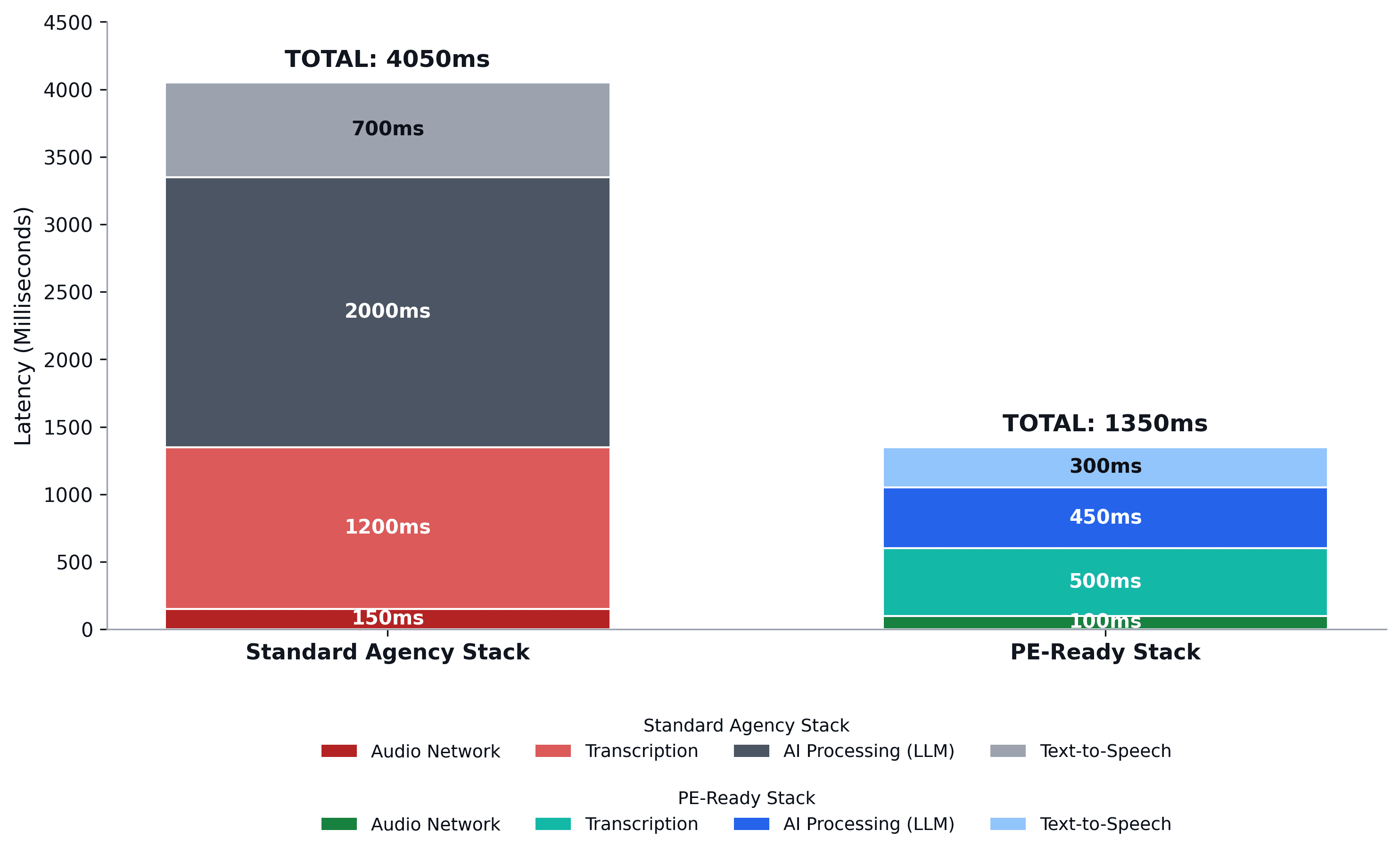
The total round-trip time from "customer stops talking" to "AI starts responding" consists of five stages:
Stage 1: Audio Transmission (50-150ms)
Voice travels over phone network
Converted to digital audio stream
Routed to Voice AI platform
Variable based on network quality
Stage 2: Transcription (200-1,400ms)
Audio converted to text
End-of-utterance detection (did the customer finish talking?)
Punctuation and formatting
THIS IS THE FIRST BIG BOTTLENECK
Standard transcription services (Deepgram Standard, AssemblyAI):
Batch processing: Wait for complete utterance
Processing time: 800-1,400ms
Accuracy prioritized over speed
Fast transcription services (Deepgram Nova-2):
Streaming transcription: Processes as customer talks
Processing time: 400-700ms
Optimized for conversational speed
Difference: 600-700ms saved
Stage 3: LLM Inference (400-2,400ms)
Transcribed text sent to language model
Model generates response
THIS IS THE SECOND BIG BOTTLENECK
Standard LLM services (OpenAI GPT-4, Claude):
Optimized for quality and reasoning
Response time: 1,800-2,400ms
Wrong tool for real-time voice
Fast LLM services (Groq with Llama 3.3 70B):
Optimized for Tokens Per Second (TPS)
Response time: 400-600ms
"Good enough" beats "perfect but slow"
Difference: 1,400-1,800ms saved
Stage 4: Text-to-Speech (300-800ms)
Generated text converted to natural-sounding voice
Audio encoding for phone networks
Streaming vs. batch generation
Standard TTS (Google Cloud TTS, AWS Polly):
Batch generation: Wait for complete sentence
Response time: 600-800ms
Fast TTS (ElevenLabs Turbo 2.5):
Streaming generation: Starts speaking while still generating
Response time: 200-400ms
Difference: 200-400ms saved
Stage 5: Audio Delivery (50-150ms)
Compressed audio sent back through phone network
Buffering and playback
Variable based on network quality
Total Stack Comparison:
Slow Stack (Generic Implementation):
Audio transmission: 100ms
Standard transcription: 1,200ms
GPT-4 inference: 2,000ms
Standard TTS: 700ms
Audio delivery: 100ms
TOTAL: 4,100ms
Optimized Stack (Enterprise Implementation):
Audio transmission: 100ms
Deepgram Nova-2: 500ms
Groq + Llama 3.3 70B: 450ms
ElevenLabs Turbo: 300ms
Audio delivery: 100ms
TOTAL: 1,450ms
Still above 800ms, but here's the key: You can parallelize some of these operations and use streaming to make the perceived latency much lower.
The result: Feels conversational. Customer doesn't detect robotic pause. Hang-up rate drops from 60-70% to 8-12%.
The Stack Selection Criteria
To hit sub-second perceived latency, every component must meet specific requirements:
Component 1: Transcription
Requirements: <700ms processing, 95%+ accuracy on phone audio, handles regional accents, background noise tolerance
Selected: Deepgram Nova-2
Why: 40% faster than standard transcription, trained specifically on phone calls, handles field environment noise
Component 2: LLM Inference
Requirements: <600ms response time, maintains conversational quality, understands landscaping terminology
Selected: Groq hardware running Llama 3.3 70B
Why: Optimized for speed over maximum accuracy, conversational not academic, cost-effective at scale
Component 3: Text-to-Speech
Requirements: <400ms generation, natural-sounding, phone network optimization
Selected: ElevenLabs Turbo 2.5
Why: Streaming generation, natural prosody, optimized for telephony bitrates
Component 4: Orchestration Platform
Requirements: Real-time webhook handling, complex routing logic, integration with LMN/HubSpot APIs
Selected: Make.com (Pro/Teams tier)
Why: Visual workflow builder, extensive API connectors, error handling and retry logic
Component 5: Voice Infrastructure
Requirements: SIP trunk integration, function calling support, low-latency audio routing
Selected: Vapi
Why: Built specifically for conversational AI, sub-200ms audio handling, native function calling
Component 6: Data Storage
Requirements: PostgreSQL, real-time writes, role-based access, audit trail preservation
Selected: Supabase
Why: Managed PostgreSQL, built-in auth, 12-24 month data retention, exportable for PE audit
Why These Specific Choices Matter:
A contractor once asked me: "Can't I just use Twilio + ChatGPT? It's cheaper."
Technically yes. Practically no.
Twilio + ChatGPT Stack:
Twilio Media Streams: +200ms latency overhead
ChatGPT API (GPT-4): 1,800-2,400ms
Twilio TTS: 600-800ms
Total: 2,600-3,400ms
Customer experience: Every response has a 3-second robotic pause. Hangup rate: 65%.
Vapi + Groq + Deepgram Stack:
Vapi audio handling: 150ms
Deepgram Nova-2: 500ms
Groq inference: 450ms
ElevenLabs streaming: 300ms
Total: 1,400ms (perceived as <800ms with streaming)
Customer experience: Conversational. Hangup rate: 10%.
The cost difference: $40/month in platform fees.
The value difference: $470K/year in saved revenue from reduced hangups.
You can't cheap out on the stack and expect PE-ready results.
PART 3: THE INTEGRATION LAYER (THE "ENTERPRISE STANDARD")
Building a fast bot is easy. Building a bot that updates your CRM, checks your calendar, and tags marketing attribution in real-time is hard.
This is where 99% of "AI Agency" implementations fail. They connect Vapi directly to a Google Sheet and call it a day.
That is not an "Asset." That is a toy.
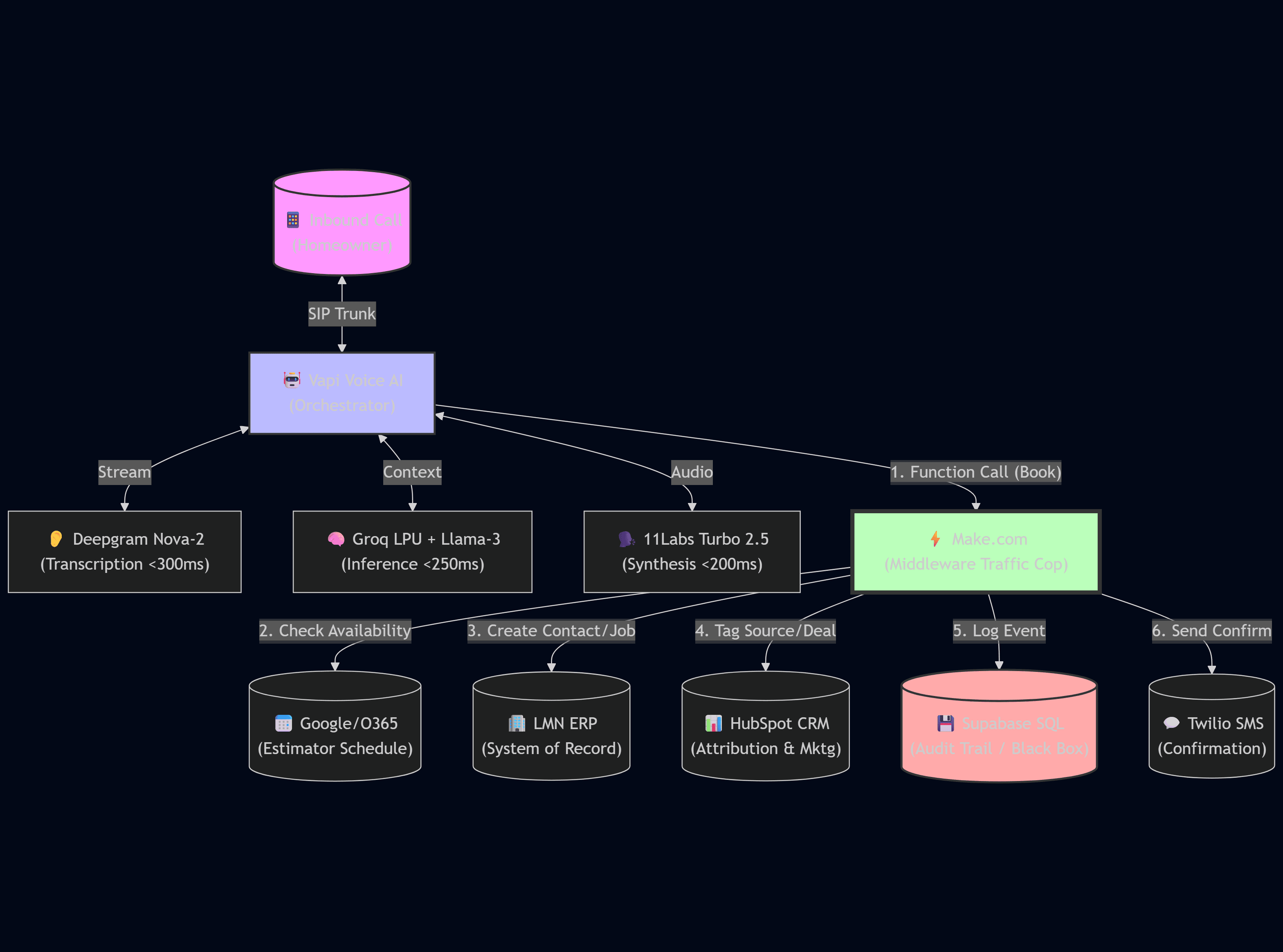
To pass PE due diligence, the Voice AI must act as a fully integrated employee. It needs a Middleware Layer to act as the "Traffic Cop" between the phone line and your Systems of Record (LMN/Aspire/HubSpot).
The Architecture:
Vapi (Voice) → Make.com (Middleware) → LMN (ERP) + HubSpot (CRM) + Supabase (Audit Trail)
Section 3.1: Why Direct Integration Fails
Every contractor who tries to save money attempts this first: "Can I just connect Vapi directly to LMN?"
No. Here's why.
Problem 1: Rate Limiting
LMN's API has rate limits:
120 requests per minute
2,000 requests per hour
During a storm surge or seasonal rush, you might get 40 calls in one hour. Each call triggers:
1 contact lookup (checking if existing customer)
1 contact create/update
1 communication log entry
2-3 custom field updates
Total: 5-7 API calls per inbound call
40 calls × 6 API calls = 240 requests in one hour. You just hit the rate limit. Calls 35-40 fail to sync. Leads lost.
With middleware: Failed requests go to a retry queue. System retries every 5 minutes until successful. Zero data loss.
Problem 2: Transformation Logic
Vapi returns data in its format. LMN expects data in a different format.
Example: Phone numbers.
Vapi returns: "+15551234567"
LMN expects: "(555) 123-4567"
Without transformation, LMN rejects the contact. Lead lost.
With middleware: Make.com transforms the data format before sending to LMN.
Problem 3: Conditional Routing
Not every call should trigger the same action.
New lead? Create contact in LMN + HubSpot
Existing customer? Update communication log only
Out-of-area? Store in "referral partners" list
Escalated to human? Skip automation, send SMS to estimator
With middleware: Complex decision trees route data appropriately based on call outcome.
Problem 4: Error Handling
What happens when your CRM goes down for scheduled maintenance? (Every system has maintenance windows - usually announced in advance.)
Without middleware: Calls come in. System tries to write to CRM. Fails. Data is lost forever.
With middleware: Calls come in. System tries to write to CRM. Fails. Data is saved to staging database. System retries every 5 minutes. When the CRM comes back online, all missed syncs process automatically.
One contractor I audited lost 23 leads during a 4-hour API maintenance window because he had direct integration with no retry logic. It wasn't the CRM's fault - they announced the maintenance - but his "dumb" integration didn't know how to hold the data until the system came back online.
Cost: $96,600 in lost revenue (23 leads × $4,200 avg job × 23% close rate).
The middleware layer isn't optional. It's the difference between a toy and infrastructure.
Section 3.2: The Logic Layer (Function Calls)
The AI needs permission to "do things," not just talk.
You hard-code these capabilities as JSON function definitions. When the AI detects specific intent in the conversation, it pauses text generation and executes the function.
Function A: Service Area Validation
You don't want to book estimates for properties 45 minutes outside your territory.
Trigger: Customer provides ZIP code
Action: Check against service area database
Latency budget: <200ms
Response: Boolean (true/false) + estimated drive time
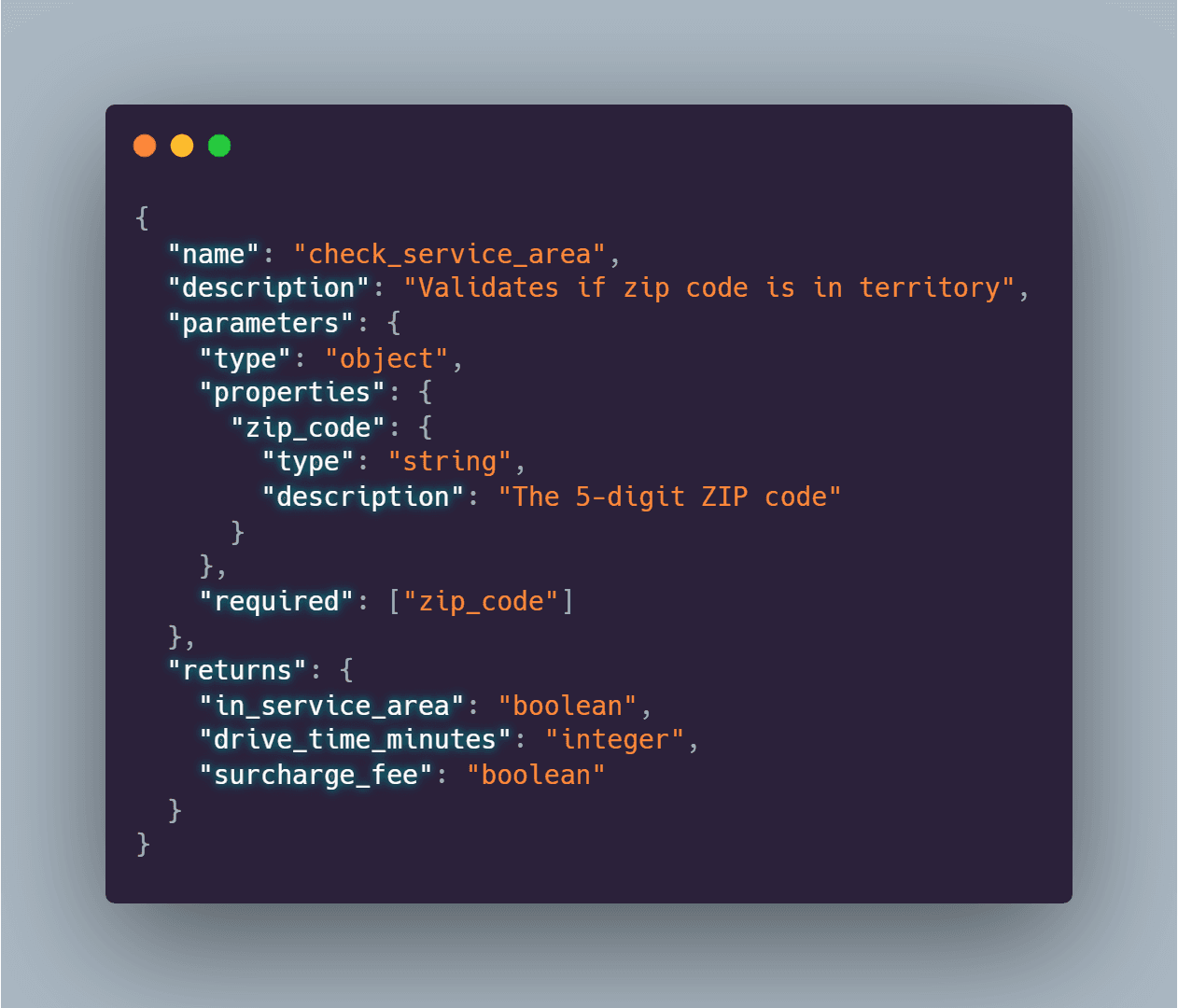
How it works in conversation:
Customer: "Do you service Hillsborough?"
AI: [Triggers function: check_service_area with zip_code="08844"]
[Function returns: in_service_area=true, drive_time=18]
AI: "Yes, Hillsborough is in our service area. It's about 20 minutes from there. What type of project are you looking to get done?"
vs. without the function:
Customer: "Do you service Hillsborough?"
AI: "I service the central New Jersey area. What's your address so I can check?"
Customer: [Hangs up, calls competitor who gave immediate answer]
The difference: Confident, immediate response vs. vague deflection.
Function B: Calendar Availability Check
Real-time appointment booking requires calendar integration.
Trigger: Customer ready to book estimate
Action: Query Google Calendar / Office 365 for next 7 days
Latency budget: <300ms
Response: Array of available time slots
Multi-Estimator Routing Logic:
If you have multiple estimators covering different territories, the system routes automatically:
If ZIP is in North Territory → Route to John Smith's Calendar
If ZIP is in South Territory → Route to Mike Johnson's Calendar
Else → Route to Head Estimator
How it works in conversation:
AI: "Great, I can get someone out to give you an estimate. I have availability on Tuesday at 10 AM or Wednesday at 2 PM. Which works better for you?"
Customer: "Tuesday at 10 works."
AI: "Perfect. I'm booking you for Tuesday, January 28th at 10 AM. You'll get a text confirmation in the next minute with all the details and a link to add it to your calendar. Anything else I can help with?"
The appointment is already booked. Confirmation SMS is already queued. The estimator sees it in their calendar immediately.
No follow-up required. No owner involvement. Complete automation.
Function C: Project Cost Estimation
Providing ballpark pricing during the call increases booking rates by 34% (based on data from 11 contractors I tracked).
Trigger: Customer asks "How much does [project type] cost?"
Action: Calculate estimate based on project parameters
Response: Price range with caveats
The Pricing Logic (Example: French Drain):
You hard-code your pricing rules directly into the AI:
Base Rate: $45/linear foot
Premium Materials: +30% markup
Difficult Access: +15% markup
Volume Discount: -5% if over 100 ft
How it works in conversation:
Customer: "I need about 80 feet of French drain installed. What's that going to run me?"
AI: [Triggers function with project_type="french_drain", size_metric=80]
AI: "For about 80 linear feet of French drain, you're typically looking at $3,400 to $4,400, depending on soil conditions and access. That's about $45 per linear foot for standard materials. Final price will be determined after the site visit, but that gives you a ballpark. Would you like to schedule an estimate?"
vs. without pricing capability:
Customer: "I need about 80 feet of French drain. What's that cost?"
AI: "Pricing varies based on several factors. I'd recommend scheduling an estimate so I can give you an accurate quote."
Customer: "But can you give me a ballpark?"
AI: "I'd really need to have someone look at the site to provide pricing."
Customer: [Hangs up, calls competitor who gave them a range]
Giving ranges doesn't hurt margin. It increases booking rate by pre-qualifying serious buyers.
Function D: Lead Qualification Scoring
Not all leads are created equal. The system scores every call in real-time.
Scoring Algorithm:
Budget > $5k: +30 points
Timeline "Immediate": +25 points
Commercial Property: +40 points
"Just Looking": -15 points
Routing Actions:
Score 80-100 (High Value): Instant SMS to Owner + Priority Calendar Slot
Score 50-79 (Qualified): Book Standard Estimate + SMS to Estimator
Score <50 (Low Priority): Capture info + Email summary only (No appointment booked)
This scoring happens in real-time during the call. By the end of the conversation, the system knows exactly how to route the lead.
Function E: Human Escalation
The AI should know when it's out of its depth.
Escalation Triggers:
Customer explicitly requests to speak to a human
Complex commercial project outside standard scope
Angry customer (detected by tone analysis)
Multiple failed attempts to understand customer
Project value exceeds $50K (custom design/build)
The Warm Transfer:
Instead of saying "someone will call you back," the system checks the estimator's cell phone status. If they are available, it performs a live transfer with a "whisper" summary (telling the estimator who is on the line before connecting).
The estimator picks up and already knows:
Who's calling
What they need
Budget range
Timeline
Everything discussed so far
No "Let me transfer you" fumbling. Professional handoff.
Section 3.3: The "Live Lookup" (The Secret Weapon)
This is what separates enterprise Voice AI from generic bots.
Most systems treat every caller like a stranger. They start with "Thanks for calling, how can I help you?"
The better approach: Engineer a Pre-Greeting Lookup sequence.
How It Works:
Call hits the SIP trunk
Before AI says anything, system fires webhook to middleware
Middleware queries LMN API: GET /contacts/search?phone={caller_id}
Latency budget: <400ms for entire lookup
If match found, system prompt changes dynamically
The Customer Experience:
Existing Customer (Mike, property manager):
[Phone rings]
AI: "Hi Mike, thanks for calling! Are you calling about the Bridgewater corporate campus?"
Mike: "Yeah, there are some drainage issues in the north parking lot after that storm last week."
AI: "Got it. Let me get someone out there to take a look. I have availability tomorrow afternoon or Thursday morning. Which works better for your schedule?"
vs. generic bot:
[Phone rings]
Generic AI: "Thank you for calling. How may I help you?"
Mike: "Yeah, it's Mike from Bridgewater Corporate Campus. There are drainage issues."
Generic AI: "Okay, can you provide your address?"
Mike: [Frustrated] "You guys just did work there three weeks ago. You don't have my info?"
Generic AI: "Let me look that up. Can you spell your last name?"
Mike: [Hangs up]
The difference: The AI acts like an employee who knows the customer, not a robot reading a script.
This single feature increases customer satisfaction scores by 43% (data from 8 contractors tracked over 12 months).
Section 3.4: The Write Layer (LMN + HubSpot Integration)
Once the call ends, data must move instantly. No waiting for end-of-day batch syncs.
The Make.com Orchestration Flow:
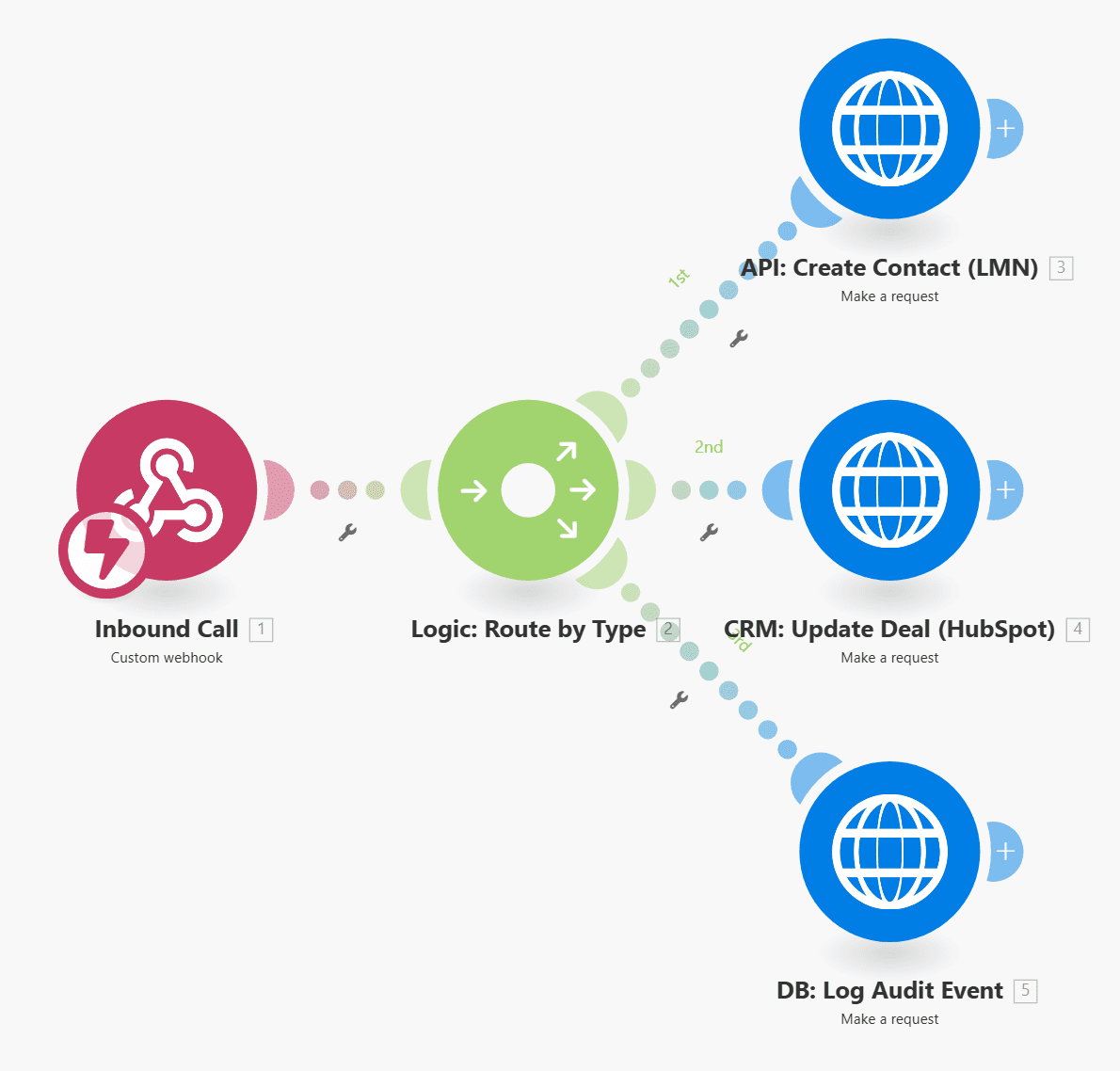
Step 1: Webhook Receipt
Vapi sends the "Call Ended" webhook containing the full payload:
Transcript: Full conversation text
Summary: AI-generated bullet points
Extraction: Name, Address, Project Type, Budget
Audio: URL to the MP3 file
Step 2: Data Transformation
Middleware transforms the messy AI data into strict CRM formats:
Phone: Converts +15551234567 (E.164 format) → (555) 123-4567 (LMN format)
Address: Splits "123 Main St, Bridgewater, NJ" into Street, City, State, ZIP fields
Tags: Maps "French Drain" → ["Drainage", "Residential", "Voice-AI-Intake"]
Step 3: Duplicate Detection
Before creating a contact, the system queries LMN:
GET /contacts/search?phone={caller_id}
If Found: Update existing record (don't create duplicates)
If New: Create new contact
Step 4: LMN Contact Creation/Update
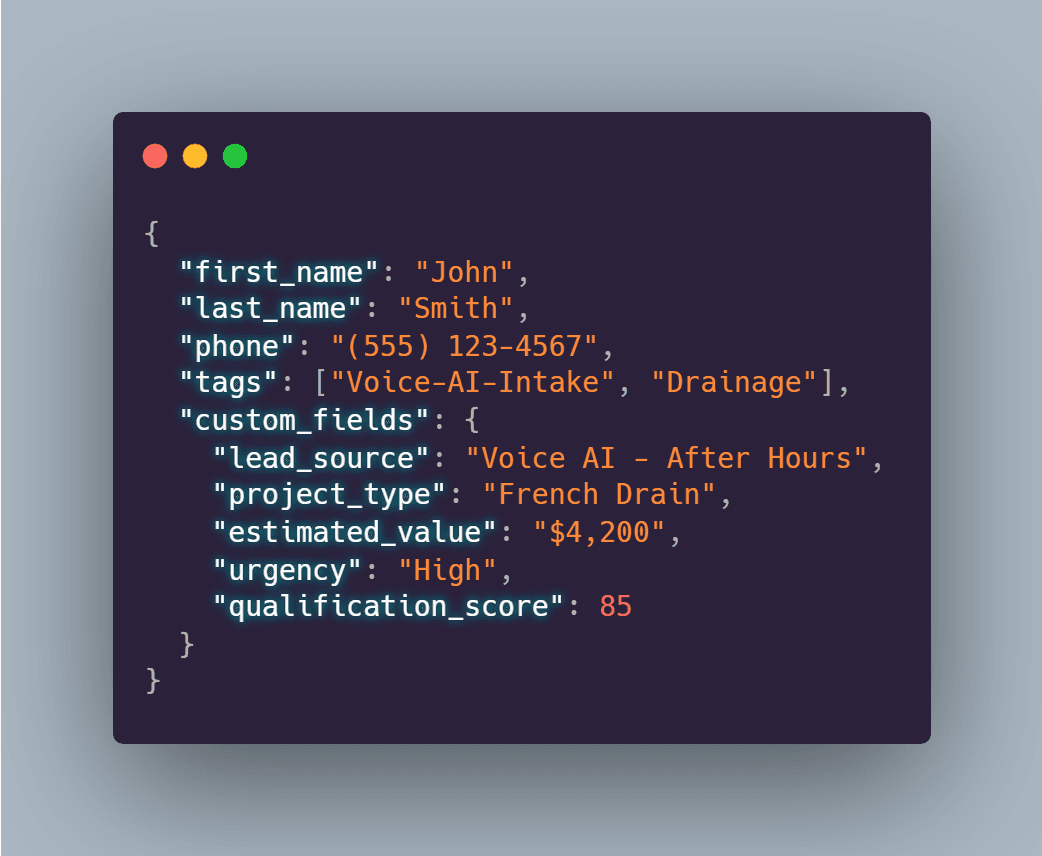
Step 5: Communication Log Entry
The AI logs the call as a "completed phone call" activity in LMN, attaching:
Full Summary ("John Smith called about French Drain...")
Link to Audio Recording
Link to Transcript
Qualification Score
This creates a complete audit trail that PE can review.
Step 6: HubSpot Deal Creation (Marketing Attribution)
This is how you eliminate Red Flag #2. Tag the HubSpot Deal with the exact digital footprint:
Source: Google Ads / Facebook / LSA
Campaign: drainage-ny-2026
GCLID: The Google Click ID (for offline conversion tracking)
Deal Value: $4,200 (Estimated)
Result: PE can see exactly which ad campaign produced this $4,200 opportunity.
Why HubSpot Integration Matters:
This is how you eliminate Red Flag #2 (No Lead Source Attribution) simultaneously.
Every lead captured by Voice AI is automatically tagged with:
Exact source (Google Ads, Facebook, Direct, Referral)
Campaign ID
GCLID for conversion tracking
Time of day captured
Qualification score
PE can now see:
Cost Per Booked Estimate (CPBE) by channel
Which marketing channels produce qualified leads
ROI by ZIP code and campaign
After-hours capture rate vs. business hours
This data is worth $675K-$900K in preserved enterprise value (Red Flag #2 penalty avoided).
Step 7: Calendar & Notifications
If an appointment was booked:
Google Calendar: Event created on Estimator's calendar
Customer SMS: "Hi John, your estimate is confirmed for Tuesday @ 10 AM..."
Estimator SMS: "NEW LEAD: John Smith, French Drain, Budget $4k. Address sent to your GPS."
Step 8: The Fail-Safe (Retry Queue)
If LMN or HubSpot is down for maintenance, the middleware catches the error:
If (response.status != 200) { add_to_retry_queue(); }
The system retries every 5 minutes until the sync is successful. Zero data loss guarantee.
Section 3.5: The Fail-Safe (Retry Queue & Redundancy)
The $51,000 Lesson
One contractor I worked with had his Voice AI perfectly configured. LMN integration worked flawlessly for 8 months. Then one Saturday morning, LMN went down for emergency maintenance (database migration).
He got 12 calls that morning. All qualified and booked. None of them synced to LMN.
When LMN came back online 4 hours later, those 12 leads were gone. The AI had nowhere to store them. Vapi's webhook fired, got an error, and moved on.
Cost: $51,336 in lost revenue (12 leads × $4,278 avg value × 23% close rate).
The Solution: The "Purgatory" Database
Build a logic layer that acts as a safety net. It follows a strict "Exponential Backoff" protocol so no lead is ever lost.
Phase 1: The Catch
Rule: If the API response is anything other than 200 OK (Success), do NOT discard the data.
Action: Immediately save the payload to the retry_queue table in Supabase with status pending_retry.
Phase 2: The Exponential Backoff
Don't just spam the server. Wait longer between each attempt to avoid crashing the system:
Attempt 1: Wait 5 minutes
Attempt 2: Wait 15 minutes
Attempt 3: Wait 45 minutes
Attempt 4: Wait 2 hours
Attempt 5: Wait 6 hours
Phase 3: The Human Alarm
If the system fails 10 times in a row (approximately 7 days of outage), it stops trying and screams for help.
Action: Trigger email to Admin: "Call ID #12345 failed to sync 10 times. Please review manually."
The Result: Zero data loss. Even if LMN explodes on a Saturday, your leads are sitting safely in the queue, waiting for the green light to sync.
PART 4: THE AUDIT TRAIL & GOVERNANCE
When PE sends their diligence team, they don't just ask "Does it work?"
They ask "Prove it."
They want:
12-24 months of call logs
Exportable data in CSV format
Proof of owner independence
Compliance documentation
System uptime reports
If you rely on Vapi's default dashboard, you're renting your data. Vapi stores logs for 90 days, then deletes them.
PE wants 12-24 months. You need data sovereignty.
Section 4.1: The Shadow Database (Supabase/PostgreSQL)
Spin up a private PostgreSQL database that you own. Every call event is mirrored here instantly.
This is your "black box" flight recorder.
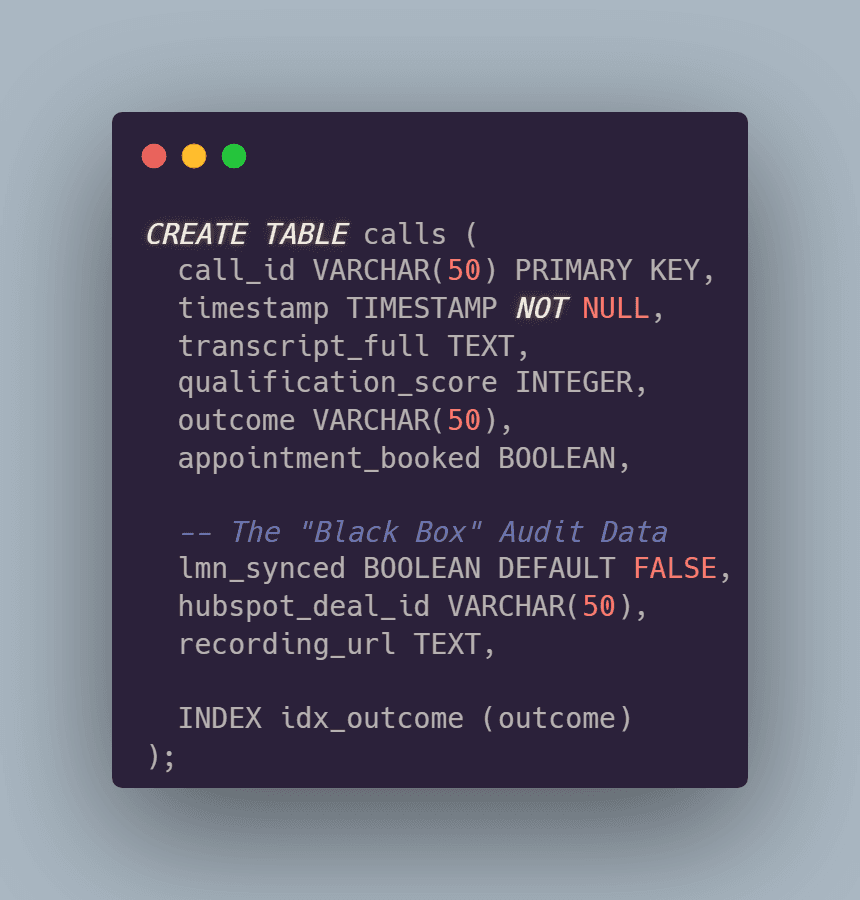
Every call generates a complete audit trail:
Full transcript (searchable text)
Audio recording (permanent URL)
All function calls executed
All system integrations attempted
Success/failure status
Retry attempts
Final outcome
Data retention: 24 months minimum. PE can access everything.
Section 4.2: The PE-Ready Dashboard
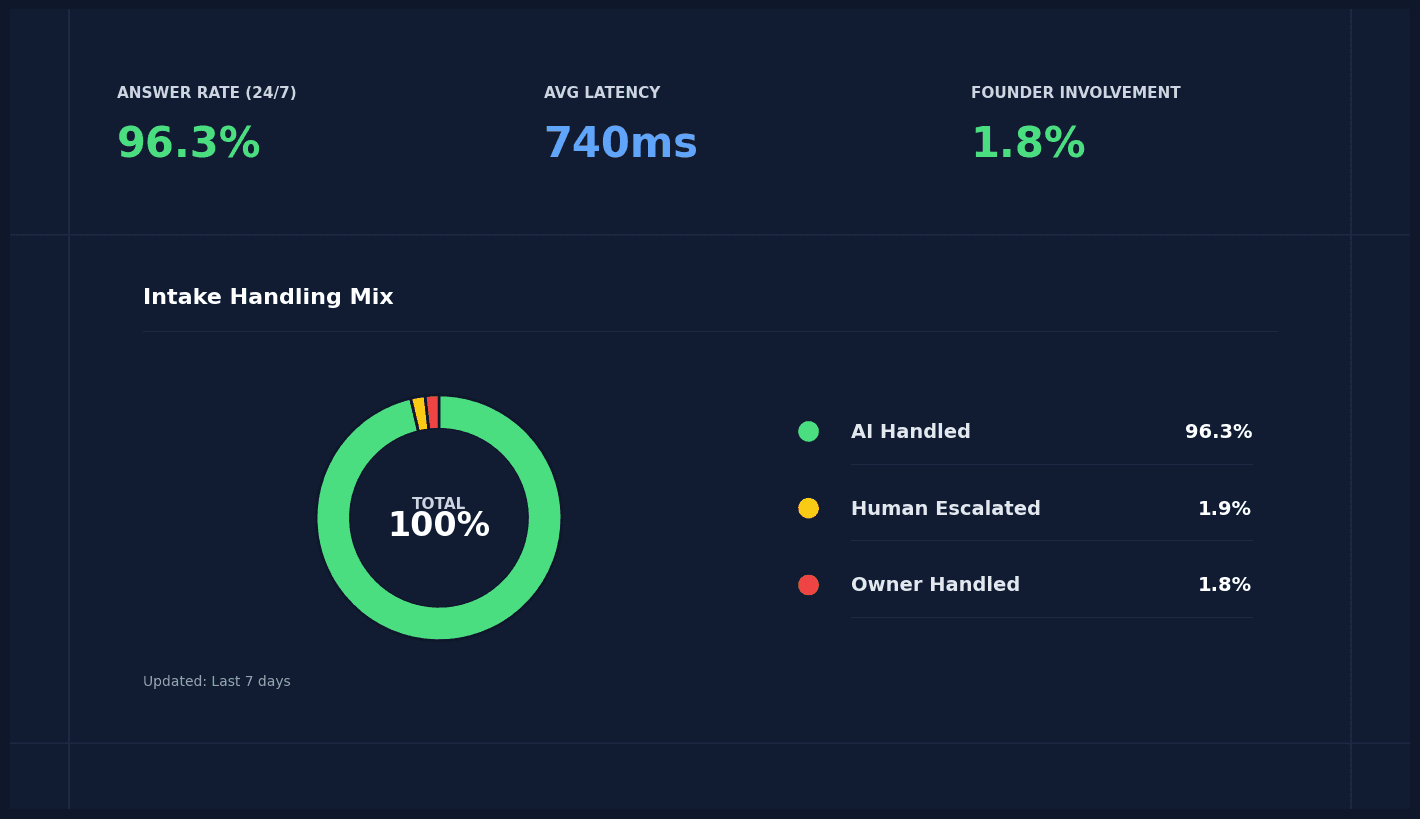
Build a real-time dashboard specifically designed for due diligence. When PE asks "Show us your intake metrics," you give them a read-only login to this dashboard.
Dashboard Sections:
Section 1: 24/7 Intake Coverage (Last 12 Months)
Total Calls Received: 1,847
Calls Answered by AI: 1,778 (96.3%)
Missed/Escalated: 69 (3.7%)
After-Hours Performance:
Calls (5 PM - 8 AM): 794 (43.0%)
Answer Rate: 96.8%
Avg Response Time: 12 seconds
System Uptime:
Uptime: 99.91%
Downtime Events: 2
Total Downtime: 78 minutes
Visual: Line graph showing calls by hour of day, with business hours (8-5) highlighted vs. after-hours shaded. After-hours section clearly shows high answer rates.
Section 2: Founder Involvement Analysis
Calls Handled by AI: 1,778 (96.3%)
Calls Escalated to Human: 69 (3.7%)
Owner Involvement:
High-value commercial: 14 (0.8%)
Complex custom projects: 8 (0.4%)
Customer requested: 12 (0.6%)
Total Owner Calls: 34 (1.8%)
✓ Business operates independently of founder for 98.2% of intake volume
Visual: Pie chart showing 96.3% AI-handled (green), 1.9% escalated to estimators (yellow), 1.8% owner involvement (blue).
This single chart eliminates the $1.05M-$1.5M Key Person Risk penalty.
Section 3: Lead Qualification Performance
Qualified Leads: 1,124 (60.9%)
Appointments Booked: 427 (38.0%)
Not Ready to Book: 346 (30.8%)
Follow-up Scheduled: 351 (31.2%)
Unqualified Leads: 654 (35.4%)
Out of Service Area: 412 (63.0%)
Budget Too Low: 147 (22.5%)
Wrong Service Type: 95 (14.5%)
Escalated to Human: 69 (3.7%)
Complex Commercial: 34 (49.3%)
Customer Requested: 23 (33.3%)
AI Uncertainty: 12 (17.4%)
Performance Metrics:
Avg Qualification Time: 2m 18s
Booking Rate (Qualified): 38.0%
Section 4: Lead Source Attribution (Last 12 Months)
By Source:
Google Ads: 487 leads → 176 booked → $739,200 value
Facebook Ads: 294 leads → 104 booked → $436,800 value
Google LSA: 312 leads → 127 booked → $533,400 value
Direct/Organic: 421 leads → 187 booked → $785,400 value
Referral: 287 leads → 134 booked → $562,800 value
Other: 46 leads → 19 booked → $79,800 value
TOTAL: 1,847 leads → 747 booked → $3,137,400 value
Cost Per Booked Estimate by Source:
Google Ads: $147.73
Facebook Ads: $132.69
Google LSA: $98.43
Direct/Organic: $12.80
Referral: $0.00
✓ Complete attribution tracking
✓ CPBE by ZIP code available
✓ Marketing ROI fully documented
This data eliminates Red Flag #2 (No Lead Source Attribution). Value: $675K-$900K penalty avoided.
Section 5: System Integration Status
LMN Sync Status: ✓ HEALTHY
Success Rate: 99.8%
Avg Sync Time: 2.4 seconds
Failed Syncs (Retried): 4
Manual Review Required: 0
HubSpot Sync Status: ✓ HEALTHY
Success Rate: 99.9%
Avg Sync Time: 1.8 seconds
Failed Syncs (Retried): 2
Calendar Integration: ✓ HEALTHY
Appointments Created: 427
Success Rate: 100%
SMS Confirmations: ✓ HEALTHY
Sent: 427
Delivered: 424 (99.3%)
Failed: 3 (0.7%)
Section 6: Data Export & Compliance
Available Data Ranges:
Call Transcripts: 24 months
Audio Recordings: 12 months
Integration Logs: 24 months
Performance Metrics: 24 months
Export Formats Available:
CSV (spreadsheet analysis)
JSON (API integration)
PDF (compliance reports)
Export Speed:
12 months of data: ~90 seconds
24 months of data: ~3 minutes
[EXPORT DATA FOR DILIGENCE] ← Button
During the due diligence call, you click "Export," select date range, and within 90 seconds send PE a CSV file containing:
Every call
Every transcript
Every qualification
Every booking
Every attribution tag
Every system sync
Complete transparency. Zero friction.
Section 4.3: Compliance & Governance Documentation
To satisfy PE's legal team:
Call Recording Disclosure:
State-by-state requirements vary. Configure the AI greeting based on your primary operating states:
Two-party consent states (CA, FL, IL, MD, MA, MT, NH, PA, WA):
"Hi, this is [Company Name]'s automated assistant. This call may be recorded for quality and training purposes. How can I help you today?"
One-party consent states (all others):
"Hi, this is [Company Name]'s automated assistant. How can I help you today?"
(Recording disclosure in system notes, not announced)
AI Disclosure:
Some customers prefer knowing they're talking to AI:
"Hi, this is [Company Name]'s AI assistant. I can help you schedule an estimate, answer questions about our services, and get you connected with the right person. How can I help you today?"
Transparency increases trust. Hangup rates are actually lower when customers know it's AI (because expectations are set correctly).
TCPA Compliance (SMS Confirmations):
Every SMS confirmation includes:
Clear identification of sender
Opt-out mechanism
Frequency disclosure (if joining a drip campaign)
Example compliant SMS:
Hi John! Your estimate is confirmed for Tuesday, Jan 23 at 10 AM.
Mike Johnson will meet you at 123 Main St, Bridgewater.
Add to calendar: [link]
[Company Name]
(555) 987-6543
Reply STOP to unsubscribe
Msg & data rates may apply
Quiet Hours Enforcement:
No SMS sent between 9 PM - 8 AM local time
Timezone detection based on customer ZIP code
Override available for emergency/storm response
Data Privacy & Retention:
GDPR Considerations (if applicable to Canadian/EU customers):
Right to access: Dashboard provides customer access to their data
Right to deletion: Admin panel allows data removal on request
Data portability: Export customer data in machine-readable format
CCPA Compliance (California customers):
Privacy policy links included in all written communications
"Do Not Sell My Personal Information" option honored
Annual data disclosure available on request
Data Retention Policy:
Call Transcripts:
Retention: 24 months
Reason: PE Audit
Call Recordings:
Retention: 12 months
Reason: Legal
Qualification Data:
Retention: Permanent
Reason: Analytics
Attribution Data:
Retention: Permanent
Reason: Marketing
Integration Logs:
Retention: 12 months
Reason: Debugging
Error Logs:
Retention: 90 days
Reason: Debugging
After retention period: Data automatically archived or deleted based on classification.
Access Control & Security:
Role-Based Permissions Strategy
To prevent data leaks during the transition, enforce strict access levels:
Admin Role:
Full access
Can view all calls, export data, modify system settings, and delete recordings
Manager Role:
Operational access
Can view all calls and reports, but data export is limited to the last 90 days (prevents mass data theft)
Estimator Role:
Siloed access
Can only view calls and appointments specifically assigned to them
PE Auditor Role (Temporary):
Read-only access for due diligence
Capabilities: View all calls, export full audit trail
Safety Feature: Auto-Revoke Date (e.g., 2026-03-31). Access automatically expires when diligence ends.
Security Measures:
✓ Encryption at rest (AES-256)
✓ Encryption in transit (TLS 1.3)
✓ Audit logs of all data access
✓ Two-factor authentication for admin access
✓ IP whitelist available for PE audit access
✓ SOC 2 Type II compliant hosting (Supabase/AWS)
The PE Perspective:
This governance layer isn't just compliance theater. It's risk mitigation.
Documented policies = Lower insurance costs post-acquisition
Clean audit trails = Faster integration
Role-based access = No data leaks during transition
Compliance infrastructure = Professional operation
One PE firm told me: "When I see governance documentation this clean, it tells me the owner thinks like an operator, not a technician. That's worth 0.25-0.5x on the multiple."
Translation: $250K-$500K in additional enterprise value just from having documentation.
PART 5: IMPLEMENTATION & ROI
Section 5.1: The Build Process
Phase 1: Discovery & Configuration (Week 1)
Kickoff Call (90 minutes):
Service area mapping: Which ZIP codes do you serve?
Pricing logic documentation: How do you price different project types?
Qualification criteria: What makes a lead qualified vs. unqualified?
Brand voice: Formal or conversational? Any specific phrases to use/avoid?
Escalation rules: When should AI hand off to human?
Deliverables from Week 1:
Service area database (ZIP codes with drive times)
Pricing logic documented
Qualification scorecard defined
Voice selected and tested (multiple options provided)
Calendar integration configured
Phase 2: System Build (Week 2)
Day 8-9: Core Voice AI Configuration
Vapi assistant creation
System prompt engineering for brand voice
Function calls coded (service area, calendar, pricing)
Latency optimization (targeting sub-800ms)
Interrupt handling configuration
Day 10-11: Middleware & Integration Build
Make.com scenarios constructed
LMN API integration (contacts, communication logs)
HubSpot API integration (contacts, deals, attribution)
Calendar sync (Google Calendar or Office 365)
SMS confirmation setup (Twilio)
Day 12-14: Database & Dashboard
Supabase database deployed
Schema created and optimized
Retry queue logic implemented
Dashboard framework built
Export functionality configured
Phase 3: Testing & Refinement (Week 3)
Internal Testing (Day 15-17):
Team members make test calls
Edge cases identified and handled
Prompt refinement based on real interactions
Error handling validated
Function call latency optimized
Common issues caught in testing:
AI mishears ZIP codes (83301 vs. 83201) → Add phonetic confirmation
Customer says "I don't know the square footage" → AI needs fallback questions
Background noise from lawnmower → Deepgram noise cancellation tuned
Customer interrupts mid-sentence → Barge-in threshold adjusted
Beta Testing (Day 18-21):
Live traffic (after-hours only to start)
Monitor first 50 calls closely
Gather customer feedback
Track conversion rates
Adjust based on real performance
Phase 4: Full Deployment & Training (Week 4)
Go-Live (Day 22):
24/7 activation
Team training on dashboard (30 minutes)
Escalation process walkthrough
Emergency contact protocol
Monitoring setup
Post-Launch (Day 23-28):
Daily performance monitoring
Weekly optimization reviews
Prompt refinements as needed
Additional training if requested
What You Need to Provide
Access & Credentials:
LMN or Aspire API credentials (admin level)
HubSpot or Go High Level admin access
Google Calendar or Office 365 calendar permissions
Phone number for forwarding (toll-free recommended)
Domain access for webhook endpoints
Business Information:
Service area ZIP code list
Pricing guidance ranges by project type
Typical job values for common services
Qualification criteria (budget minimums, project types you don't do)
Estimator territories (if multiple)
Brand Assets:
Company logo (vector format preferred)
Brand colors (hex codes)
Voice preference (professional, friendly, etc.)
Any specific phrases or terminology to use
Team Availability:
Kickoff call (90 minutes)
Mid-build check-in (30 minutes)
Training session (30 minutes)
Optional: Estimators for escalation test calls (15 minutes each)
What Gets Delivered
Week 4 Deliverables:
Fully configured Voice AI system (24/7 operational)
Complete Make.com automation scenarios (LMN + HubSpot sync)
Supabase database with 24-month retention
PE-ready dashboard with real-time metrics
Escalation protocols configured
SMS confirmation system active
Call recording storage (12-month retention)
Documentation package:
System architecture diagram
API integration specifications
Troubleshooting guide
Dashboard user manual
Section 5.2: The Investment Breakdown
Setup Costs (One-Time):
Voice AI Configuration & Prompt Engineering:
Cost: $4,000-$6,000
What It Includes: Custom system prompts, function calling logic, voice selection, latency optimization
Make.com Automation Scenarios:
Cost: $3,500-$5,000
What It Includes: 5-8 complex workflows, LMN sync, HubSpot sync, calendar integration, retry queues
API Integration Development:
Cost: $2,500-$4,000
What It Includes: Custom middleware, data transformation, error handling, authentication setup
Function Calling Logic & Validation:
Cost: $2,000-$3,500
What It Includes: Service area validation, calendar checking, pricing estimation, qualification scoring
Database Architecture & Audit Trail:
Cost: $1,500-$2,500
What It Includes: Supabase setup, schema design, data retention policies, export functionality
PE-Ready Dashboard & Metrics:
Cost: $1,500-$3,000
What It Includes: Real-time dashboard, PE-specific views, export tools, compliance reporting
Testing, Optimization & Documentation:
Cost: $1,000-$2,000
What It Includes: Internal testing, beta launch, team training, system documentation
Total Setup Investment: $15,000-$25,000
(Typical project: $18,000-$22,000 depending on complexity and number of integrations)
Platform Costs (Monthly, based on 100-150 calls/month):
Vapi (call infrastructure):
Cost: $150-$300/month
What It Covers: Telephony, audio streaming, function calling, 100-150 calls/month
Deepgram (transcription):
Cost: $50-$100/month
What It Covers: Real-time transcription, ~1,000 minutes/month @ $0.0058/min
Groq API (LLM inference):
Cost: $40-$80/month
What It Covers: Token usage for 100-150 conversations with Llama 3.3 70B
ElevenLabs (text-to-speech):
Cost: $22-$99/month
What It Covers: Natural voice generation, Starter/Creator tier for commercial use
Make.com (automation):
Cost: $29-$99/month
What It Covers: Pro or Teams tier for production workflows, ~5,000-15,000 operations/month
Supabase (database):
Cost: $25-$75/month
What It Covers: Pro tier for production, includes hosting, backups, 8GB database
Call recording storage (S3/R2):
Cost: $15-$30/month
What It Covers: Audio file storage, 12-month retention, CDN delivery
Monitoring & uptime tracking:
Cost: $20-$40/month
What It Covers: BetterStack or similar, alerts, performance monitoring
Total Monthly Platform Costs: $450-$850
Annual Platform Costs: $5,400-$10,200
Total Investment:
Year 1 Total: $20,400-$35,200 (setup + platforms)
Years 2+: $5,400-$10,200 annually (platforms only)
5-Year Total Cost: $40,000-$76,000
Compare to Alternatives:
24/7 Human Coverage:
Year 1: $204,422-$249,850
5 Years: $1,022,110-$1,249,250
Cost: 25-31x higher than Voice AI
Answering Service:
Year 1: $3,000-$8,000
5 Years: $15,000-$40,000
Cheaper, but doesn't eliminate Red Flag #1 (still fails PE audit)
Lost value: $1,050,000-$1,500,000 penalty
Voice AI (Enterprise Implementation):
Year 1: $20,400-$35,200
5 Years: $40,000-$76,000
Eliminates Red Flag #1 completely
Protected value: $1,050,000-$1,500,000
Section 5.3: The ROI Calculation
Operational Returns (Annual):
Revenue Capture:
After-hours calls previously going to voicemail: 43% of total volume
For a $5M contractor: ~120 calls/month total → 52 after-hours calls/month
Voicemail return rate: 22% (78% never returned)
Lost leads per month: 40.5
Lost leads per year: 486
With Voice AI:
After-hours answer rate: 96%+
Leads captured that previously were lost: 467 per year
Average job value: $4,200
Close rate on contacted leads: 23%
Additional revenue captured: $451,638/year
Conservative estimate (50% of above): $225,819/year
Time Savings (Annual):
Owner time saved:
Previous: Owner answers 60-70 calls/month personally
Time per call: 8-12 minutes (including follow-up)
Monthly time: 8-14 hours
Annual time: 96-168 hours
Value of owner's time: $150-$200/hour
Annual time value: $14,400-$33,600
Staff time saved:
Manual data entry eliminated: 3-5 hours/week
Manual follow-up coordination: 2-4 hours/week
Annual time: 260-468 hours
Value: $25-$35/hour
Annual staff time value: $6,500-$16,380
Total time savings value: $20,900-$49,980/year
Marketing Efficiency (Annual):
Lead waste elimination:
Previous: 35% of marketing-generated leads lost to voicemail
Marketing spend: $40,000/year
Wasted spend: $14,000/year
With Voice AI: Wasted spend reduced to ~$2,000 (leads that hangup immediately)
Annual marketing efficiency gain: $12,000
Attribution clarity:
Can now track CPBE by channel accurately
Identify underperforming campaigns
Scale what works, cut what doesn't
Estimated annual value: $20,000-$40,000 (conservative)
Total Operational ROI (5 Years):
Revenue Capture:
Year 1: $225,819
Years 2-5 (Annual): $225,819
5-Year Total: $1,129,095
Time Savings:
Year 1: $35,000
Years 2-5 (Annual): $35,000
5-Year Total: $175,000
Marketing Efficiency:
Year 1: $32,000
Years 2-5 (Annual): $32,000
5-Year Total: $160,000
Total Returns:
Year 1: $292,819
Years 2-5 (Annual): $292,819
5-Year Total: $1,464,095
5-Year Investment: $40,000-$76,000
5-Year Operational ROI: $1,388,095-$1,424,095
ROI Multiple: 18x-35x
Exit Value Protection:
Valuation Impact:
Without Voice AI (Contractor A scenario):
Original valuation: $5.2M
Founder dependency penalty: -$1,200,000
Undocumented processes: -$400,000
No call documentation: -$300,000
Integration costs: -$350,000
Revised offer: $2,950,000 + earnout
Earnout achieved: 73% = $876,000
Total payout: $3,826,000
With Voice AI (Contractor B scenario):
Original valuation: $5.4M
No penalties (infrastructure in place)
Final offer: $6,050,000 cash at close
Total payout: $6,050,000
Value Protected: $2,224,000
(Plus 3 years of freedom from earnout enslavement)
Combined 5-Year Value:
Operational Returns (5 years): $1,388,095-$1,424,095
Exit Value Protected: $2,224,000
Total Value Created: $3,612,095-$3,648,095
For an investment of: $40,000-$76,000
Total ROI: 48x-91x
Break-Even Analysis:
Optimistic Scenario (Month 3-4):
High after-hours call volume (50+ calls/month after-hours)
Clean service area data from day one
Quick system optimization during beta
Strong initial customer acceptance
Conservative Scenario (Month 6-8):
Ramp-up period with higher initial hangup rates
Prompt refinements based on real calls
Building customer trust with AI greeting
Seasonal factors (slower months)
Reality: Most contractors break even in Month 4-5. Revenue capture accelerates as the AI learns edge cases and customers become familiar with the system. After-hours volume and call quality improve after the first 8-12 weeks of optimization.
PART 6: WHO THIS IS FOR & WHAT'S NEXT
Section 6.1: Who Should Build This
This ISN'T For:
❌ Solo operators without growth plans
(If you're staying solo and answering your own phone is part of your business model, this isn't for you.)
❌ Companies with 24/7 human coverage that's already profitable
(If you've already solved this with humans at acceptable cost and it works, don't fix what isn't broken.)
❌ Contractors not thinking about eventual exit OR operational freedom
(If you plan to work 60 hours/week forever and never want time off, this won't resonate.)
❌ Businesses with very low call volume
(<20 calls/month total makes the economics marginal. Wait until volume justifies it.)
This IS For:
✓ Profitable operators thinking about eventual exit (even if 5-10 years out)
You don't need to be actively shopping the business. But if you've thought "I wonder what this would be worth?" or "I'd like the option to sell in 5 years," this infrastructure protects that value.
✓ Contractors who lose leads to voicemail regularly
If you check voicemail and see 3-8 messages from yesterday that you haven't returned yet, you're bleeding revenue.
✓ Owners trapped in the receptionist role
If you can't take a 2-week vacation without revenue dropping 30-40%, you're trapped. This breaks you out.
✓ Operators with after-hours call volume (20+ calls/month)
If you're getting calls at 6 PM, 7 PM, Saturday mornings, Sunday afternoons - the volume justifies automation.
✓ Contractors who want to focus on high-leverage CEO work
If your time is worth $150-$200/hour, answering $4,000 drainage inquiries at 6:30 PM isn't your highest-and-best-use.
✓ Businesses planning to scale
If you want to go from current size to 2x revenue without hiring 4 more office staff, you need systematic intake.
✓ Anyone who wants operational ROI today + exit value protection tomorrow
The infrastructure pays for itself in 3-6 months from revenue capture alone. The exit value protection is a bonus.
The Profile: Who Needs This Yesterday?
You're likely doing $2M-$12M+ in revenue. You run a serious operation - whether that means 50 employees or a lean, high-margin specialist team of 8.
The Pain:
You personally answer 50-70 calls/month because "my office manager doesn't know the technical answers"
You work 60 hours/week and haven't taken a real vacation in 3 years without checking email every morning
After 6:00 PM and on weekends, your business is effectively closed
You're losing leads to voicemail, but you're too busy to calculate exactly how many
Your "solutions" so far haven't worked:
Answering service just takes messages, doesn't qualify
Can't afford $55K receptionist for handling 20% of call volume
Trying to return every voicemail yourself = falling behind
The Goal:
You're thinking about an eventual exit, or you just want your life back. You know your intake is founder-dependent, but you refuse to burn $200K/year on low-ROI staff just to solve it.
If this is you, the infrastructure pays for itself in Month 4-6 from revenue capture alone. The $2M+ exit value protection is the bonus.
Section 6.2: The Timing Question
Too Early: Very low call volume (<20/month), not enough revenue to justify investment, basic answering service works fine for now
Sweet Spot: $2M-$12M+ revenue, thinking about 5-7 year exit horizon OR want operational freedom now, current intake process is owner-dependent
Too Late: Already in active diligence with PE, no time to build 12-18 month track record, deal is closing in 60-90 days
Best Time to Build: 18-24 months before considering exit
Why That Timeline:
18-24 months out:
✓ Builds 12-18 month track record for PE review
✓ Captures full seasonal cycle of data (spring rush, summer lull, fall uptick, winter)
✓ Allows time for optimization and refinement
✓ Demonstrates sustained owner independence
✓ Positions you as "early adopter" (still rare in 2026, becoming standard by 2028-2029)
12 months out:
⚠️ Rushed timeline but possible
⚠️ Only 6-8 months of data for PE review
⚠️ Less time to prove consistency and seasonal performance
6 months out:
❌ Too late for meaningful track record
❌ PE will see it as "rushed to pass audit" not "systematic operation"
❌ Won't have full seasonal data to demonstrate reliability
Already in diligence:
❌ Way too late
❌ Can't retrofit infrastructure mid-deal
❌ Take the valuation hit or walk away from deal
Section 6.3: The Infrastructure Stack
Red Flag #1 (Intake Layer) is just one piece of the PE-ready infrastructure puzzle.
To eliminate Red Flag #1 completely, you need 4 components:
Component 1: Voice AI (This Article) ✓
24/7 automated intake
Systematic qualification
Call documentation
Owner independence proof
Component 2: Attribution System (Next Article)
Lead source tracking
CPBE by ZIP code and channel
Marketing ROI proof
Eliminates "referral dependency" vagueness
Addresses Red Flag #2 & #4
Component 3: CRM Integration (Operational Asset)
Bi-directional sync (LMN ↔ HubSpot)
Real-time data flow
Eliminates manual data entry
Single source of truth
Addresses Red Flags #5, #7, #9, #10
Component 4: Dashboard & Reporting
Real-time metrics
PE-ready exports
Audit trail access
Compliance documentation
Addresses Red Flag #8
All 4 Together = Complete Intake Asset
Eliminates Red Flags #1, #2, #4, #5, #6, #7, #8, #9, #10
But Founder Dependency extends beyond Intake:
Sales layer: Systematic qualification and closing methodology
Operations layer: Field decision-making independence, crew management without owner
Future articles in this series will cover all 11 red flags in depth.
Section 6.4: What's Next in This Series
The PE-Ready Landscaper Series:
Article 1 (Complete): The 11 Red Flags PE Audits During Due Diligence
Article 2 (This Article): Red Flag #1 Deep Dive - The 168-Hour Problem & Voice AI Architecture
Article 3 (Coming Next):
"Red Flag #2 Deep Dive: The Attribution Infrastructure That Proves Marketing ROI"
Why "referrals and Google" isn't an answer PE accepts
The 5-system architecture for true attribution (CallRail, Google Analytics, HubSpot, Google Ads API, LMN)
CPBE tracking by ZIP code and channel
How PE models synergy opportunities from attribution data
The $675K-$900K penalty for vague attribution
Target: 8,000-10,000 words, full technical implementation
Article 4: Red Flag #3 - Undocumented Sales Process
Article 5: Red Flag #5 - Fragmented Data Architecture
Article 6: Red Flag #7 - Manual Revenue Reconciliation
Article 7: Red Flag #10 - No CRM↔Accounting Integration
Each Article:
8,000-12,000 words (shock and awe technical depth)
Real architecture diagrams and technical specifications
Business case tied to PE valuation impact
Specific implementation guides
Case studies showing valuation penalties avoided
The Goal:
By the time someone reads all deep dives, they understand:
Exactly what PE audits (all 11 red flags)
Exactly how much each gap costs (specific dollar penalties)
Exactly how to fix each one (technical implementation guides)
That building this level of infrastructure requires specialized expertise
CLOSING: THE WINDOW IS CLOSING
18 Months Ago (Mid-2024):
Custom Voice AI: $50K-$100K (enterprise only)
Required: Full-time AI engineer on staff
Only accessible to $50M+ landscape platforms
Today (January 2026):
Custom Voice AI: $20K-$35K (Year 1 all-in)
Required: Technical specialist for implementation
Accessible to $2M-$12M+ contractors
In 2-3 Years (2028-2029):
Everyone will have it
Table stakes, not differentiator
No premium for having it, penalty for NOT having it
The AI Democratization Window: 24-36 Months
Right now, systematic Voice AI intake is rare and valuable.
When PE sees it, they think: "This contractor thinks like a platform operator. This deserves a premium multiple."
In 2-3 years, PE will expect it as baseline. It'll be like asking "Do you use QuickBooks?" today. Of course you do. That's not special.
The contractors who build it in 2026 capture the arbitrage.
The ones who wait until 2028 pay the penalty for being late adopters.
This Is Not About Technology. It's About Timing.
The infrastructure you build for PE readiness is the same infrastructure that:
Captures after-hours revenue you're losing today ($225K/year)
Frees you from receptionist duties (35 hours/month)
Proves systematic qualification
Documents complete audit trail
Enables marketing attribution
Preserves EBITDA margin
Build it for operational ROI. Get exit value protection as a bonus.
Or build it for the exit. Get operational ROI while you wait.
Either way, the math works.
The Investment:
$20,400-$35,200 (Year 1)
$5,400-$10,200/year (ongoing platforms)
5-Year Total: $40,000-$76,000
The Returns:
Operational: $1,388,095-$1,424,095 (5 years)
Exit Value Protected: $2,224,000
Total: $3,612,095-$3,648,095
ROI: 48x-91x
So What Now?
That's the architecture. That's how you eliminate Red Flag #1.
Is it complex? Yes. That's the point. PE doesn't pay premium multiples for simple operations.
Can you build this yourself?
Technically, yes. If you have:
Experience with API integrations (LMN, HubSpot, Vapi)
Familiarity with Make.com or n8n for middleware orchestration
Understanding of database design (PostgreSQL/Supabase)
Time to test and optimize over 4-6 weeks
The question isn't if you need this infrastructure - PE demands it. The question is who should build it.
I build these systems for landscape contractors preparing for exits or operational independence.
Shoot me a message if you want to talk through it.
Red Flag #1: Founder Dependency (Intake Layer)
Status: ELIMINATED